
As a Chinese teacher, over the years I’ve come to see that there are particular topics and language points that students seem to have a ‘mental block’ with, to the point now where I can usually predict in advance which particular content will prove to be a stumbling block with most students. In this post, I want to give you a quick checklist of some of those, so you can make sure that you are okay with them.
标签存档:grammar
Like or not? Like! Like then buy! Not buy – where have money?? Regardless have or not, like then buy.
I’m pretty pleased with the title ^_^, haha. Today I want to talk about one of the key things that makes students’ Chinese sound UN-Chinese, which is anaphora & coreference – two phenomena which are exhibited by my strange title for this post.
的: What DE Heck?!!
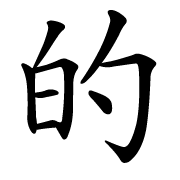
Today’s post is about a really fundamental Chinese particle, 的.
Today’s post is actually slightly abstract in nature, but it’s also about something that causes students confusion right from the beginning of their Chinese-learning journey (and I don’t blame them – it’s never really flagged in any Chinese learning resources). So, let me ask you. Why do some noun-phrases have 的 linking the adjective / description to the noun e.g. 很美的地方 and others don’t e.g. 中国菜? Can we use either? Do they have any difference in meaning? Let’s take a look!
有的 / 没的 + verb

Today’s tip is about a structure often heard in colloquial Chinese, but not too often written about ever. The pattern is as follows:
subject + 有 / 没 + 的 + action verb*
‘there’s a lot [有] / nothing [没] for + subject + to + verb’
Tips Miniseries (9/9): Pre-Verbal Objects

Okay, heads up, this is a tricky one. There’s a secret, little-known alternate position for the object in a Chinese sentence. It’s after the subject and before the verb. At the moment, we probably know of the following positions for the object:
Tips Miniseries (8/9): Duration Structure
I can’t tell you how many times I see students get their duration structure in a pickle – even advanced students seem to get this wrong quite often. By duration structure, I mean when you want to say how long an action was done for e.g. ‘I watched Korean dramas FOR 3 HOURS.’
Tips Miniseries (7/9): Topic-Comment Structure

A distinctly Chinese sentence structure is the TOPIC-COMMENT STRUCTURE. This is a structure that some of you will have heard of, some will have practiced and others will have never heard even once. For those Chinese learners who have heard of it, they nonetheless often avoid using it, because it is one of those structures that seems fairly unusual relative to how we phrase our thoughts as English-speakers.
Tips Miniseries (6/9): Slashing the ‘是’

In the same way that English-speaking students often use too many repeated pronouns in their Chinese sentences (see back to tip #4), which makes their Chinese sound rather verbose and as if it has been sautéed in a glaze of ‘English’, students also have a marked tendency to often use too many 是 in their sentences.
Tips Miniseries (5/9): Where to put ‘what’

Do you know the rule for where question words like 什么、谁、哪里、怎么 etc. go in the sentence? It’s amazing how far through the Chinese subjects students can get at university and still be quite unaware of how to work out exactly where these question words go. This important rule is, in fact, not even that often stated in textbooks. So, what is this magic rule?
Tips Miniseries (4/9): Keep Your Pronouns to Yourself, Please
As you are probably aware, Chinese very much likes to avoid repetition of information that has already been made clear from the context – particularly pronoun words like 我 I, 你 you and 他 he / 她 she. Many English-speaking students, however, copy their English a little too literally into their Chinese and excessively pepper their sentences with superfluous 我、你、他 and 她s.
 中文秘诀 | The Secret of Chinese