
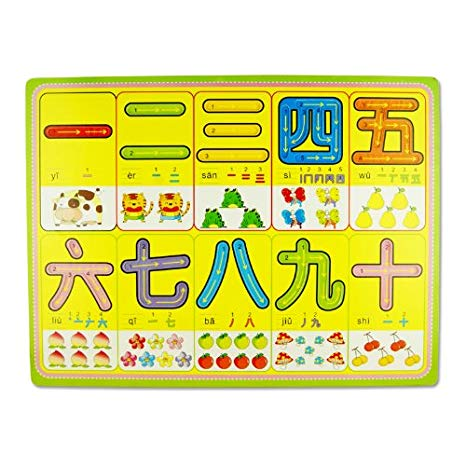
Hi guys! 好久不见! I thought I’d tide you over with a short(-ish) little (long) post about Chinese numbers that should quench your thirst for all things linguistically oriental. As some of you know, I’ve been getting into Shanghainese recently. As I was poring over my Shanghainese book (as one does on a Saturday afternoon), I was quite taken aback with how much similarity there is between Shanghainese and Japanese pronunciations of the numbers (remember that Japanese writes its numbers with Chinese characters).
Take a look at the comparison below; I’ve also included the Mandarin pronunciations and also Cantonese and to give a more comprehensive comparison. I took a look at Korean too, and from what I gather, there are two sets of numbers in Korean – ‘Sino-Korean’ pronunciations (i.e. pronunciations that are derived from Chinese) and ‘Native Korean’ pronunciations (ones which don’t seem to bear any resemblance to Chinese / Japanese). I’ve included the Sino-Korean readings also.
[Numeral / Mandarin / Cantonese / Shanghainese / Japanese / Sino-Korean]
1 一 yī / yāt / yik5 / ichi / 일 il
2 二 èr / yih / ni23 / ni / 이 i
3 三 sān / sāam / se52 / san / 삼 sam
4 四 sì / sei / si34 / shi or yon / 사 sa
5 五 wǔ / nǵh / n23 / go / 오 o
6 六 liù / lohk / lok12 / roku / 육 yuk
7 七 qī / chāt / qik5 / shichi or nana / 칠 chil
8 八 bā / baat / bak5 / hachi / 팔 bil
9 九 jiǔ / gáu / jiou34 / kyuu or ku / 구 gu
10 十 shí / sahp / zzak12 / juu / 십 ship
Depending upon how familiar you are with phonology and/or transliteration, you may or may not see some definite similarities across Mandarin, Cantonese, Shanghainese, Japanese and Sino-Korean readings. Of course, we’re probably not all that surprised given the historical relationships between China, Japan and Korea, but rather than talk about how these readings got ‘borrowed’ and then localised into the pronunciation of the language they were borrowed into, I want to do some direct sound comparisons and perhaps give you a few insights into the phonetics and phonology of the Chinosphere.
Let’s start with number 1. Clearly, there’s a lot of /i/ sounds across the board. The Chinese readings are written with an initial ‘y’, but in fact they are only semi-pronounced glides (though the ‘y’ in the Cantonese yāt is somewhat stronger than the ‘y’ in yī). As such, the pronunciations of the first row are much more similar than they might look. What’s interesting is that all but the Mandarin reading have a final / near-final consonant. Not many people know this, but Mandarin is in fact perhaps the dialect of Chinese that LEAST resembles the older pronunciations of ‘Middle Chinese’ (which basically means ‘Medieval Chinese’. Chinese used to have a much wider variety of consonant sounds that could come at the ends of words e.g. –t, -k, -p, but they disappeared from the language over time. Now, of course, -n and –ng are the only syllable-final consonants allowed in Mandarin. Cantonese and also Shanghainese here have retained traces of the phonology of the older forms. These syllable-final consonants are called ‘clipped consonants’, because the mouth moves into the shape of them, but doesn’t release the flow of air to make a fully formed consonant. As such, the tone in these kinds of syllables gets cut short (there’s also a possibility that the Cantonese ‘yāt’ is related to the other way you can say ‘one’ in Chinese – 幺 yāo). Accounting for all this, there is great similarity between the different ways that 一 is pronounced.
Weirdly, all but the Mandarin pronunciation for 二 sound more similar to ‘yī’. It looks like Korean and Cantonese have deleted the initial ‘n’ that is still retained in Shanghainese and Japanese. Interestingly, if you pronounce the Cantonese ‘yih’ and then lower the position of your tongue, you do actually kind of get an ‘er’ sound, so perhaps the Mandarin version isn’t as far away from the rest as it first seems.
三 is pretty straight forward – the only real difference is whether there is n / m at the end, which are sounds that are very close to each other in terms of where in the mouth they are pronounced. You’ll notice that Cantonese has a double ‘a’, which is in fact a ‘long A sound’. Cantonese actually differentiates ‘short A’ and ‘long A’. For example, ‘gāi’ is ’chicken’ (鸡), and if you then lengthen the vowel to ‘gāai’, the meaning changes to ‘street’ (街). Shanghainese has evidently gotten rid of any final ‘m’ or ‘n’ sound, though this is potentially explainable: if you’ve hung around native Chinese people, you may have noticed that the ‘n’ sound at the end of syllables like ‘wan’ doesn’t sound like the ‘n’ sound at the end of English words like ‘pan’ – the Chinese syllable-final ‘n’ sound is much softer, more like you say the vowel but add some ‘nasal’ feeling (this is similar to what happens when you pronounce a word like 明 with the 儿 after it – it becomes more like ‘meeer’ with a nasal sound, rather than an n(g) on the end). Perhaps with the Shanghainese pronunciation of 三, the ‘n’ was originally there, but weakened and became just a ‘bit of a nasal sound’ and maybe even eventually just disappeared.
For 四, we can see obvious similarities (note that the Japanese Romanisation ‘shi’ is pronounced like ‘sheeee’; I don’t speak Korean, but I would expect that ‘sa’ is pronounced as a very short sound). What’s interesting is that in most of the languages shown, the same pronunciation (ignoring tone) for 四 is the same as the pronunciation for 死 ‘death’. If I had to hazard a guess, I’d say that the Cantonese pronunciation is the oldest (Cantonese being a very ‘old’ dialect that has quite high similarity to ‘Medieval Chinese’ pronunciation). Probably what then happened was that the ‘e’ sound disappeared in the other languages / dialects, due to proximity to where in the mouth the ‘i’ is pronounced.
五 looks a bit trickier to see the connections with, but if we keep our heads on, we can work it out. Korean ‘o’ and the ‘u’ in Mandarin ‘wǔ’ are actually pronounced in almost the same place in the mouth (the tongue is slightly higher for ‘u’ than for ‘o’), which is up high at the back of the mouth. So how on earth do we link that with the Japanese ‘go’? Well….we do have the ‘o’ sound there, so what of the ‘g’? In fact, the ‘g’ is what we call a ‘velar sound’ – it’s pronounced with the tongue up high and fairly near the back of the mouth – OH, JUST like where ‘u’ and ‘o’ are pronounced! Coincidence? Nope! So what of the Cantonese and Shanghainese versions? Well, ‘ng’ is a ‘velar nasal’ sound, which means it’s nasal and the tongue is….. you guessed it – up high and near the back of the mouth! Shanghainese probably was very similar to the Cantonese sound originally and then dropped the ‘g’ part. Unlike in Mandarin, you’ll see that the Cantonese and Shanghainese readings have no vowel – this is actually quite a common type of syllable across Chinese dialects. Colloquial Cantonese, for instance, uses ‘ḿh’ for ‘not’ (though it’s written as 唔, rather than 不).
Alrighty, let’s proceed on to 六. The Cantonese and Shanghainese are obviously similar, and for Mandarin, remember that ‘iu’ in Pinyin is an abbreviation for the vowel sequence ‘i-o-u’, so we can see some similarity there (though, as we discussed above, the final –k has disappeared from Mandarin). Now, what’s interesting is that the Korean reading seems to have retained the ‘upper-back vowel’ + ‘k’ sequence still present in the Cantonese and Shanghainese, but also, the initial ‘y’ sound still exists in the Mandarin ‘liù’ (though we write it as an ‘i’). So, curiously, the Korean reading is the missing link between the Mandarin and Cantonese / Shanghainese! That leaves the Japanese reading: we see the ‘o’ sound and the following ‘k’ sound. The final ‘u’ is actually just because Japanese doesn’t allow consonants at the end of syllables (‘n’ excluded) and so will add an extra vowel to fit the syllable-style of Japanese. That leaves the initial ‘r’. Well, you may have heard that Japanese often mix up their ‘r’s and ‘l’s when speaking English. There’s actually a reason for this – the Japanese l / r is in fact a single sound called an ‘alveolar tap’ that sounds somewhere in-between an ‘l’ and an ‘r’. If you’re reading this in Australia, the sound is actually pretty much the same as how Aussies pronounce ‘tt’ in words like ‘letter’ (which almost sounds like ‘ledder’). So, there we go, all the links of 六 explained!
For 七, we can see the similarities between all of the languages. Interestingly, Japanese has an additional syllable at the start, ‘shi’. The Cantonese, Shanghainese and Korean all have retained a final consonant at the end – coincidentally, all the languages given here that CAN have syllable-final consonants (other than n / ng) DO in fact have one, and the languages that CANNOT have one DON’T! You may think that the final ‘t’, ‘k’ and ‘l’ still should sound very different from each other, but remember that these are ‘clipped consonants’ and are cut short. Once you make the sound very short, the sound is pretty much the same!
Okay, time for 八. We can see a familiar kind of scenario between Mandarin and Cantonese – the Cantonese has a lengthened vowel and has retained a final consonant –t. The Shanghainese also looks similar to this. Korean uses a similar pattern – an initial ‘b’ and a final consonant, though the ‘i’ vowel is noticeable different – probably some form of phonetic localisation, however, the ‘i’ sound is also present in the Japanese reading. I’d expect that the Japanese pronunciation was a borrowed version meant to sound like ‘hach’, but as we said before, Japanese syllable-structure usually requires consonants to be followed by a vowel, explained the extra ‘i’ on the end. The Japanese version does have an ‘a’ vowel like the Chinese readings, but where does the ‘h’ come from and why has it replaced the ‘b’ used in all of the others? Well helloooo, phonology may just be our friend again. You may remember that the Chinese ‘b’ sound, unlike in English, is voiceless (where voicing = the buzz in the throat when you say ‘z’ that isn’t there when you say ‘s’). The Japanese ‘b’ is similar to the English ‘b’ in that it is voiced. So, based upon voicing alone, Japanese ‘b’ isn’t a perfect candidate to transliterate the Chinese ‘b’ into Japanese. In the Japanese Hiragana script, sounds come in sequences of sounds that all start with the same consonant, for instance: ka, ki, ku, ke, ko / na, ni, nu, ne, no etc. Several of these sequences have a parallel sequence where the sounds start with a different, but related consonant, and are written with the exact same graphemes as the first sequence, just with an added ‘ten ten’ mark (it looks a bit like a double-quote mark). Look below to see what I mean:
| さ sa | し shi | す su | せ se | そ so |
| ざ za | じ ji | ず zu | ぜ ze | ぞ zo |
| は ha | ひ hi | ふ fu | へ he | ほ ho |
| ば ba | び bi | ぶ bu | べ be | ぼ bo |
The ‘ten ten’ mark in fact is used to show voicing (hence the s-sounds + ‘ten ten’ à z-sounds). And what do you notice? The voiceless version of the Japanese b-sounds is the h-sounds! So, based upon matching voiceless Chinese ‘b’ to its nearest Japanese equivalent, as strange as it may seem, Japanese ‘h’ is the closest match!
Alrighty, almost there! 九 is next. Whilst all of the readings have a strong ‘u’ sound, it’s not immediately obvious how the initial consonants of j, g and k relate. ‘g’ and ‘k’ are both ‘velar consonants’ and differ in Chinese (and possibly also Korean?) simply by aspiration (the strength of the puff of air you give when you say them). As such, the Cantonese, Japanese and Korean pronunciations of 九 are to be considered similar (though the Cantonese reading has an extra ‘a’ sound which perhaps was lost when the pronunciation was borrowed into Japanese and Korean – note, it makes sense that the Japanese and Korean readings follow the Cantonese rather than Mandarin readings, as Cantonese is the older form of Chinese and would have been more similar to the language(s) spoken in China at the time that Japan and Korea were borrowing words from Chinese). So how do we get from ‘g’ / ‘k’ to the ‘j’ in Mandarin and Shanghainese? Well, remember that Mandarin ‘j’ is NOT pronounced the same way as an English ‘j’ and the back of the tongue is pushed upwards a lot more for the Mandarin ‘j’. Assuming you are saying the Mandarin ‘j’ correctly, you should be able to move the tip of your tongue upwards a little and find that you are basically in the right position to pronounce a ‘g’. Et voila! The sound change explained.
Finally, we’re at 十. Cantonese and Shanghainese both lack the ‘sh’ sound found in Mandarin and so accordingly, have each moved to their closest equivalents in their respective dialects – Cantonese uses an ‘s’, Shanghainese uses a voiced ‘z’, which is basically an English ‘z’ that is not found in Mandarin. We can also see that Cantonese, Shanghainese and Korean have final ‘clipped’ consonants that are not present in the Mandarin pronunciation, as we’re no longer surprised to see. That just leaves us with the Japanese reading to tie in. Japanese doesn’t have the short ‘i’ sound that Mandarin has (in fact, you may find it interesting to know that very few languages in existence use that vowel), and so perhaps ‘uu’ is the nearest similar thing in the Japanese sound system. The ‘j’ sound in Japanese is actually different from English and Chinese ‘j’. You can listen to what it sounds like here: https://en.wikipedia.org/wiki/Voiced_alveolo-palatal_fricative. I don’t know about you, but I definitely hear an ‘sh’-like quality to it.
And that’s it folks! We’ve managed to work out how the numbers from 1-10 are pronounced similarly in Mandarin, Cantonese, Shanghainese, Japanese and Korean. Not a bad day’s work!
 中文秘诀 | The Secret of Chinese
Great write-up and comparison! The only thing I would like to suggest is that instead of thinking of the Japanese seven “shichi” as having an additional syllable “shi”, instead, it might be more similar to the explanation for hachi where the -i is for formality’s sake. So it is effectively a one-syllable word. Just hazarding a guess!
赞赞
Thanks for that! The devoicing of final -i is a phonological process, and so it can take some judgement to know whether that should or should not affect our sense of what the ‘core’ part of the word is. It seems that ‘sh’ is not a common sound among words for ‘seven’ across Asian languages. However, the sequence ‘ch’ + vowel + (unreleased consonant) is quite common (even in Thai, ‘seven’ is ‘chèt’). This gets me thinking that the ‘chi’ part is more the ‘core’ of the word than the ‘shi’ part. Of course, I could be wrong! Thanks for the food for thought 🙂
赞赞